2015年12月27日 星期日

Chronometer watch


The term chronometer is a specific type of timepiece tested and certified to meet certain precision standards. In Switzerland, only timepieces certified by the Contrôle Officiel Suisse des Chronomètres (COSC) may use the word 'Chronometer' on them. Outside Switzerland, equivalent bodies (such as the Japan Chronometer Inspection Institute) have in the past certified timepieces to the same internationally recognised standards, although use of the term has not always been strictly controlled.
The term chronometer was coined by Jeremy Thacker of Beverly, England in 1714, referring to his invention of a clock ensconced in a vacuum chamber. The term chronometer is also used to describe a marine chronometer used for celestial navigation and determination of longitude. The marine chronometer was invented by John Harrison in 1730. This was the first of a series of chronometers that enabled accurate marine navigation. From then on, an accurate chronometer was essential to deep sea marine or air navigation out of sight of land. Early in the Twentieth Century the advent of radiotelegraphy time signals supplemented the onboard marine chronometer for marine and air navigation, and various radio navigation systems were invented, developed, and implemented during and following the Second World War (e.g., GeeSonne a.k.a.ConsolLORAN(-A and -C), Decca Navigator System and Omega Navigation System) that significantly reduced the need for positioning using the onboard marine chronometer. These culminated in the development and implementation of global satellite navigation systems (GSN-GPS) in the last half of the 20th century. The marine chronometer is no longer used as the primary means for navigation at sea, although it is still required as a backup, since radio systems and their associated electronics can fail for a variety of reasons.
Once mechanical timepiece movements developed sufficient precision to allow for accurate marine navigation, there eventually developed what became known as "chronometer competitions" at astronomical observatories located in Europe. The Neuchâtel ObservatoryGeneva ObservatoryBesancon Observatory, and Kew Observatory are prominent examples of observatories that certified the accuracy of mechanical timepieces. The observatory testing regime typically lasted for 30 to 50 days and contained accuracy standards that were far more stringent and difficult than modern standards such as those set by COSC. When a movement passed the Observatory, it became certified as an Observatory Chronometer and received a Bulletin de Marche from the Observatory, stipulating the performance of the movement. Because only very few movements were ever given the attention and manufacturing level necessary to pass the Observatory standards, there are very few Observatory Chronometers in existence. Most Observatory Chronometers had movements so specialized to accuracy that they could never withstand being used as wristwatches in normal usage. They were useful only for accuracy competitions, and so never were sold to the public for usage. However, in 1966 and 1967,Girard Perregaux manufactured approximately 670 wristwatches with the Calibre 32A movement, which became Observatory Chronometers certified by the Neuchatel Observatory, while in 1968, 1969 and 1970 Seiko had 226 wristwatches with its 4520 and 4580 Calibres certified. These Observatory Chronometers were then sold to the public for normal usage as wristwatches, and some examples may still be found today. The Observatory competitions ended with the advent of the quartz watch movement, in the late 1960s and early 1970s, which generally have superior accuracy at far lesser costs.

精密手錶,又被稱作天文台表英語Chronometer watch),是經過測試和認證符合一定精密標準的一種手錶

クロノメーターChronometer )は、
  • 船の揺れや温度変化に影響されない、高精度な携帯用ぜんまい時計。
  • デテント式脱進機を装備した時計。
  • 天文台で精度検定を受けた時計。
  • クロノメーター検定協会による検定に合格した機械式時計。
名称はギリシア神話の時間神クロノスに由来する。クロノグラフとは名称が似ているが別物である。


Charles Darwin embarked on his journey on the HMS Beagle‪#‎onthisday‬ in 1831. The observations Darwin made on this momentous voyage would lead to his theory of evolution. This is the ship’s chronometer, made by Thomas Earnshaw, originally an extraordinarily skilled watchmaker. This chronometer is a precise timekeeper and also contains a temperature compensation balance. This balance was designed to keep the timekeeper running at a constant rate in the varying ambient temperatures encountered at sea. While the mechanisms within chronometers were simple, they were made to very exacting standards and the escapement makers, finishers and adjusters were among the highest skilled in the clock-making world. The dial indicates hours, minutes and seconds. The whole machine is housed in a simple wooden box with mounts to keep it level irrespective of the motion of the ship http://ow.ly/Vs5IQ

2015年12月22日 星期二

Bacteria that resist 'last antibiotic' found in UK. New 'superbug' found in UK hospitals


Bacteria that resist 'last antibiotic' found in UK
  • 21 December 2015
  •  
  • From the sectionHealth

Media captionWhat is a superbug?
Bacteria that resist the most common antibiotic of last resort - colistin - have been discovered in the UK.
Officials say the threat to human health is low, but is under ongoing review.
Scientists warned the world was on the cusp of a post-antibiotic era when such resistance was discovered in China last month.
Now checks have discovered the same resistance on three farms and in samples of human infections.
When all other antibiotics fail then doctors turn to colistin - that's why it is so important.
Doctors in the UK thought they had three years before colistin-resistance would spread from China to the UK.
But Public Health England and the Animal and Plant Health Agency began testing for it.
Public Health England has gone through the 24,000 bacterial samples it keeps on record from cases between 2012 and 2015.
Colistin-resistance was discovered in fifteen of them, including samples of Salmonella and E. Coli.
The Animal and Plant Health Agency has discovered colistin-resistant bacteria on three pig farms.
line break

Analysis

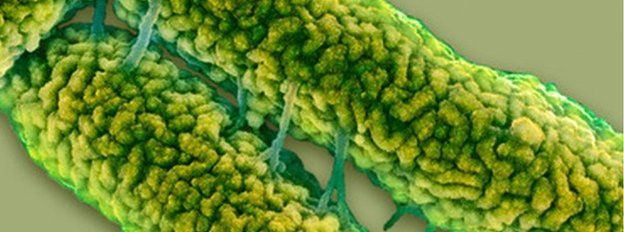
E coliImage copyrightSCIENCE PHOTO LIBRARY
The news will not be a massive surprise after similar discoveries in parts of Europe, Asia and Africa.
It raises the prospect of untreatable infections - what is known as the antibiotic apocalypse and threatens to plunge medicine back into the dark ages.
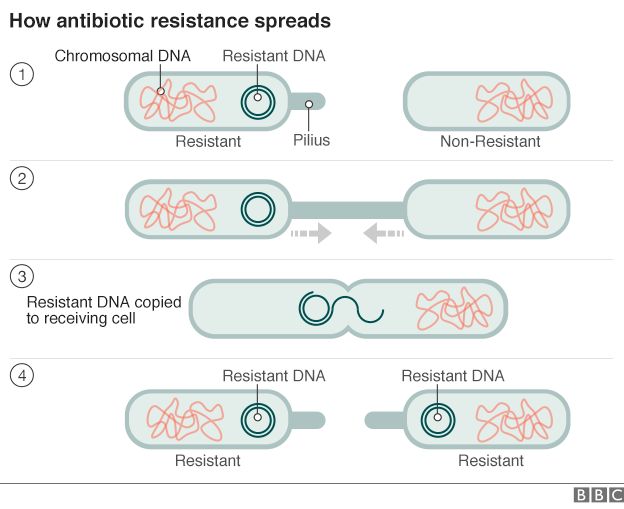
The DNA that gives bacteria resistance to colistin - the mcr-1 gene - can spread rapidly between species.
The concern is that colistin-resistance will now find its way into other superbugs to create infections that doctors cannot treat.
line break
Prof Alan Johnson, from Public Health England, said: "Our assessment is that the public health risk posed by this gene is currently considered very low, but is subject to ongoing review as more information becomes available.
"The organisms identified can be killed by cooking your food properly and all the bacteria we identified with this gene were responsive to other antibiotics, called carbapenems.
"We will monitor this closely, and will provide any further public advice as needed."
How resistance spreads
The Chinese resistance cases were down to overuse of antibiotics in agriculture.
Alliance to Save Our Antibiotics says 837kg of colistin was sold to British farms in 2014.
Coilin Nunan, from the Alliance to Save Our Antibiotics, said: "We need the government, the European Commission and regulatory bodies like the Veterinary Medicines Directorate to respond urgently.
"The routine preventative use in farming of colistin, and all antibiotics important in human medicine, needs to be banned immediately."
The Department for Environment, Food and Rural Affairs said colistin made up just 0.2% of the antibiotics used in livestock in the UK.
A spokesperson said: "We are enhancing our surveillance for colistin resistance, and veterinary prescribers have voluntarily updated prescribing guidelines to restrict use of colistin in animals."


E. coliNDM-1 has been found in E.coli bacteria
A new superbug that is resistant to even the most powerful antibiotics has entered UK hospitals, experts warn.
They say bacteria that make an enzyme called NDM-1 have travelled back with NHS patients who went abroad to countries like India and Pakistan for treatments such as cosmetic surgery.
Although there have only been about 50 cases identified in the UK so far, scientists fear it will go global.
Tight surveillance and new drugs are needed says Lancet Infectious Diseases.

Start Quote

The fear would be that it gets into a strain of bacteria that is very good at being transmitted between patients”
Dr David LivermoreResearcher from the HPA
NDM-1 can exist inside different bacteria, like E.coli, and it makes them resistant to one of the most powerful groups of antibiotics - carbapenems.
These are generally reserved for use in emergencies and to combat hard-to-treat infections caused by other multi-resistant bacteria.
And experts fear NDM-1 could now jump to other strains of bacteria that are already resistant to many other antibiotics.
Ultimately, this could produce dangerous infections that would spread rapidly from person to person and be almost impossible to treat.
At least one of the NDM-1 infections the researchers analysed was resistant to all known antibiotics.
Similar infections have been seen in the US, Canada, Australia and the Netherlands and international researchers say that NDM-1 could become a major global health problem.
Infections have already been passed from patient to patient in UK hospitals.
Map showing infection hotspots in the UK and India
The way to stop NDM-1, say researchers, is to rapidly identify and isolate any hospital patients who are infected.
Normal infection control measures, such as disinfecting hospital equipment and doctors and nurses washing their hands with antibacterial soap, can stop the spread.
And currently, most of the bacteria carrying NDM-1 have been treatable using a combination of different antibiotics.

Analysis

The Indian health ministry and the medical fraternity are yet to see the Lancet report but doctors in India say they are not surprised by the discovery of the new superbug.
"There is little drug control in India and an irrational use of antibiotics," Delhi-based Dr Arti Vashisth told the BBC.
Doctors say common antibiotics have become ineffective in India partly because people can buy them over the counter and indulge in self-medication. They also take small doses and discontinue treatment.
Gastroenterologist Vishnu Chandra Agarwal says in the past year he has come across many patients with E.coli infections who have not responded to regular antibiotics.
"In about a dozen cases, I have used a chemical - furadantin - to treat my patients. And it has worked. It makes them horribly nauseous, but it works," he says.
But the potential of NDM-1 to become endemic worldwide is "clear and frightening", say the researchers in The Lancet infectious diseases paper.
The research was carried out by experts at Cardiff University, the Health Protection Agency and international colleagues.
Dr David Livermore, one of the researchers and who works for the UK's Health Protection Agency (HPA), said: "There have been a number of small clusters within the UK, but far and away the greater number of cases appear to be associated with travel and hospital treatment in the Indian subcontinent.
"This type of resistance has become quite widespread there.
"The fear would be that it gets into a strain of bacteria that is very good at being transmitted between patients."
He said the threat was a serious global public health problem as there are few suitable new antibiotics in development and none that are effective against NDM-1.
The Department of Health has already put out an alert on the issue, he said.
"We issue these alerts very sparingly when we see new and disturbing resistance."
Travel history
The National Resistance Alert came in 2009 after the HPA noted an increasing number of cases - some fatal - emerging in the UK.
The Lancet study looked back at some of the NDM-1 cases referred to the HPA up to 2009 from hospitals scattered across the UK.
At least 17 of the 37 patients they studied had a history of travelling to India or Pakistan within the past year, and 14 of them had been admitted to a hospital in these countries - many for cosmetic surgery.
For some of the patients the infection was mild, while others were seriously ill, and some with blood poisoning.
A Department of Health spokeswoman said: "We are working with the HPA on this issue.
"Hospitals need to ensure they continue to provide good infection control to prevent any spread, consider whether patients have recently been treated abroad and send samples to HPA for testing.
"So far there has only been a small number of cases in UK hospital patients. The HPA is continuing to monitor the situation and we are investigating ways of encouraging the development of new antibiotics with our European colleagues."
The Welsh Assembly Government said it would be "fully considering" the report.
"The NHS in Wales is used to dealing with multi-resistant bacteria using standard microbiological approaches, and would deal with any new bacteria in a similar way," said a spokesperson.

More on This Story

Related stories