Internet of Things: it's all coming together for a tech revolution
Imagine if your kitchen scales could advise you about nutrition or if your lavatory could tell you to see a doctor. The Internet of Things is making these ideas possible, but at what price?
 Email
Email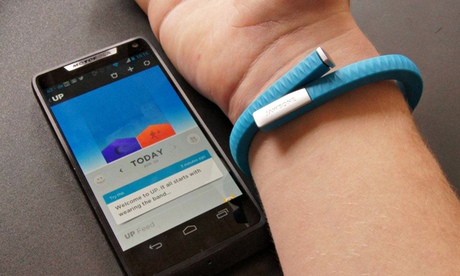
Fitness trackers : Jawbone recently filed a patent for a method of measuring body fat percentage using smartphones. By sending impulses from the phone using its vibrate feature, the device would wobble your fat, measure the frequency of the wobbles and so allow it to determine your body fat percentage. This could then be used to create a more tailored fitness regime.
The Internet of Things may be one of the clumsier neologisms to have emerged in recent times, but that has seemingly done nothing to slow its growth. For those unfamiliar with it, the Internet of Things (also known as M2M or machine to machine) refers to an expanding network of interconnected internet-enabled devices. Driven by miniaturisation, the affordability of components such as cheap Bluetooth sensors, and the growing ubiquity of technologies such as Wi-Fi, it is now possible to connect devices in a way that would never have previously been thought possible. While still in its "early adopter" infancy, some estimates suggest that by 2020 there will be in the region of 50bn IoT devices – all talking with one another on a constant basis.
"Consumers are beginning to realise that this technology isn't an outlandish, futurist concept coming to life from The Jetsons but in fact can be used efficiently and effectively to solve everyday problems," says Alex Hawkinson, CEO of home automation company SmartThings. "The top-use cases have to do with security, peace of mind and savings. For example, consumers can be notified when a door is opened or there is motion while they're away. They can be notified when there is moisture in the basement and they can programme the lights and heat to turn off when no one is present in the house, which can mean huge energy savings."
Already tech giants are getting involved, viewing this as a logical progression from the personal computer and smartphone races of previous decades. At its Worldwide Developers conference (WWDC)event last Monday, Apple introduced Homekit, an Internet of Things platform that will co-ordinate various third-party home automation accessories, allowing you to unlock your doors or turn on and off your lights via your iPhone.
Google, too, demonstrated its interest by paying $3.2bn (£1.9bn) earlier this year to buy Nest Labs, a home automation company co-founded by the creator of the iPod. Already well known for its connected thermostats and smoke detectors, Nest is currently investigating a slew of other applications related to the home – everything from health tracking to security systems.
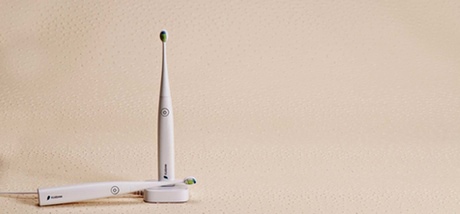 This Bluetooth-enabled, Kickstarter-funded toothbrush made by French startup Kolibree will calculate and rate your brushing style, keep track that you’ve found all the right places and provide you with real-time feedback. The firm suggests you can transform otherwise boring dental hygiene activities into a competitive family game.
What unites products as seemingly disparate as driverless cars and fitness-tracking wearables such as the Jawbone UP is their ability to collect data from, and on behalf of, their users.
"When people talk about the Internet of Things, they tend to get hung up on the 'things' themselves," says Ian Foddering, chief technology officer and technical director at Cisco UK and Ireland. "Actually, the real value and insight comes from the data that these devices provide. We're just at the tip of the iceberg when it comes to what is possible in terms of data extraction. It's a very exciting time."
"Data empowers us," says Renee Blodgett, vice president of marketing and strategy at Kolibree, the world's first connected electric toothbrush(yes, really!). "For the first time, we have data on how we brush our teeth, where we brush our teeth and where we need to improve. Before now, we would only get that feedback from our dentist once a year when we have our annual cleaning. Now, we can get that feedback in real time."
While marginal gains in toothbrushing might not sound like much, the overall point about the power of big data is certainly valid.
Entrepreneur and former Apple employee Mike Grothaus agrees. Earlier this year, Grothaus successfully used a Kickstarter campaign to create SITU, a set of kitchen scales that relays data about nutrition to your iPad. Such was the demand for SITU that the project received almost 30% of its funding in the first day alone.
"It's a revolution," Grothaus says of the burgeoning connectivity. "It won't be as flash or obvious as the smartphone revolution, but it will be more profound because it connects everything together."
But if the Internet of Things is revolutionary, it is also, in a sense, evolutionary.
"In the early 20th century, all sorts of devices and objects became electrical," says Rafi Haladjian, founder of Sen.se and an IoT pioneer. "Irons, kettles and washing machines all used to be mechanical; then suddenly this great new technology came along. The same thing is happening today."
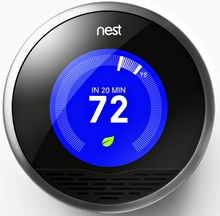 Smart thermostat : the Nest thermostat in your home learns your preferences and automatically adjusts itself to the correct temperature, enabling users to save money and energy. Connected to a smartphone app, it also lets users control the thermostat when on the go.
What differentiates Internet of Things devices from the PCs, tablets and smartphones that came before them is their invisibility. The likes of Kolibree or SITU come with no screen or traditional input device such as a keyboard. "The most profound technologies are those that disappear," wrote Mark Weiser, the chief technology officer of Xerox PARC, in the early 1990s. "They weave themselves into the fabric of everyday life until they are indistinguishable from it."
Sometimes, these devices are indistinguishable from the world around them on account of their sheer scale. Fritz Lang's 1927 silent movie Metropolis depicted the city as one giant organism, and that is now a possibility in the world of hyper-connected cities, in which even the pipes that carry our water and the roads we drive on contain smart components.
In other cases, it might be that the technologies are so small that we do not readily see them. The dream of those working in the biotech field today is for physical augmentations that constantly monitor our wellbeing – with sensors and microscopic robots in the circulatory system, tracking blood pressure and scanning for early-stage cancers. While we don't yet have all the details about Apple's work in this area, it seems clear that this is the domain innovations such as the just-announced HealthKit (and possibly the forthcoming iWatch) will focus on.
At the moment, people who choose to track and share their data still represent a minority. But while no one is going to force you to wear a connected device (in most jobs), those who do will become increasingly common – and will be incentivised for it. The car insurance companyDrive Like a Girl, for instance, installs on-board car computers that monitor your driving and offers cheaper premiums to those drivers who prove less likely to have an accident. "We use the latest telematics technology to give girls the fair price they deserve, not because they are female, but because they are safer drivers," the company's website states. "With telematics, they can prove it."
Perhaps more intrusive is the idea of an Internet of Things-enabled lavatory, which uses sensors inside the bowl to sample your stool and provide health-related insights. By testing urine, these sensors might be able to detect hormone changes in a woman and advise if she is pregnant. It could similarly look for bacterial infections and suggest whether you can stick to Pepto-Bismol or should seek medical advice. If neither of these sounds enough of an incentive to ditch your lavatory for one with its own Twitter account, you may be in the minority: a recent survey suggested that 70% of people would be willing to share data from their lavatory if this could lead to healthcare savings.
In a post-Edward Snowden world, the Internet of Things will raise questions about privacy. Freedom through surveillance is a remnant of George W Bush's America. Now, however, that same ideological stance extends to our gadgets. As always, this isn't a straightforward equation – a panopticon effect in which we are monitored by a faceless watchman and receive nothing in return.
IoT devices offer new ways for us to take control of our lives, but also paradoxically cede that same control. It is here that a techno-sceptic likeEvgeny Morozov enters the frame. In his latest book, To Save Everything, Click Here, Morozov takes issue with what he terms "solutionism": the idea that everything from obesity to global warming can be solved with the aid of a few interconnected devices. Viewing self-tracking as the epitome of the "modern narcissistic quest for uniqueness and exceptionalism," Morozov pointedly asks why anyone would want to turn every aspect of their lives into a "temple of surveillance."
Will these concerns be enough to put people off using such devices? Concerns have already been raised about the implications of Google's expansion into the IoT field since its purchase of Nest Labs – a byproduct of which would be that the Silicon Valley giant would hold ever more granular data about its users.
Beyond this are issues about security – such as what would happen in the event that our devices were hacked by someone with the ability to shut off our water supply, or take control of our cars, or unlock the doors of our houses from thousands of miles away. For those working in the field, however, these are temporary concerns, which can be addressed with the right amount of planning.
"There is no reason why organisations today should not have a robust end-to-end security policy," says Cisco's Ian Foddering. "It is something that needs to be considered, but I think these are all concerns that can also be addressed today."
Q&A: Chip designer Ian Ferguson
How is the Internet of Things going to change the world?
We're going to see more technology that's woven into the fabric of the planet – whether it's intelligent lighting systems or microcontrollers in parking spaces so you can detect whether the space is available using your smartphone.
How has this affected ARM's business?
Our business works by licensing technology, primarily processors [including to Apple], meaning the intelligence that is in a smartphone or the braking system of a car, for example. We want to provide the technology that makes it as easy as possible for companies to get connected products into the marketplace.
What's been responsible for the recent surge of interest in this area?
First, there are so many smartphones, companies can think about providing technology that uses that technology as a way of connecting – whether that's a fitness band or Google Glass or a smartwatch. Second, we've seen innovative groups such as the "maker" community come together to connect things to the internet in innovative ways. Crowdfunding platforms such as Kickstarter have helped build and test all kinds of connected devices.
Apple has its new HomeKit platform for co-ordinating home automation accessories using the iPhone. What does this mean for a company such as Apple?
If you look at what Apple does very well, it has an App Store that gets software developed for iOS. When I consider what is going to be important in the consumer space, it's about getting Internet of Things applications developed for various devices. Just having something connected to a phone doesn't really help – it's all about what you do with the data. You need a means of connecting all these devices together.
What do you see being the big ethical questions involved with this?
Security is a big one. For us as ARM, better security means more CPU intelligence, which potentially increases the cost of a device – or else lowers how long it might last on a single battery charge. We need to continue to look at how we evolve to let people still build compelling technology within cost, energy and security expectations. LD
Ian Ferguson is vice president at ARM

